
The grocery stores with the cheapest weekly shops
Updated on 09/18/2024
By Mackenzie

When it comes to grocery shopping, finding the right balance between quality and affordability is crucial. Who doesn’t want to save a few extra dollars every week without compromising the essentials? Let’s dive into which grocery stores offer the best savings!
- New data has crowned Aldi the cheapest grocery store for the weekly shop, with an average weekly grocery shopping trip costing $185.18
- Walmart is in second place, with $225.22, and Target took third place, with $239.62
- The data used analyzed the cost of an average weekly shopping trip for an average US household of three from the six biggest American grocery stores
The 6 Cheapest Grocery Stores
Our saving experts here at BravoDeal have analyzed the cost of an average weekly grocery shopping trip from six major American grocery stores. The average cost was based on the current average US household size of 2.51 – this was rounded up to a household size of 3 for the study's purposes. The stores were then ranked to determine which offered the lowest-priced weekly grocery shop.
Stretching your grocery budget has never been easier thanks to this new data. Our team at BravoDeal has compiled the data into an easy guide for your next budget-friendly grocery shopping experience.
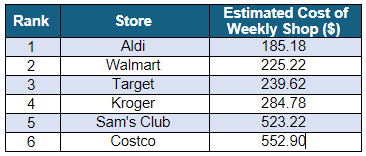
1. Aldi - The winner
Aldi, the German, family-owned multinational discount store, offers the cheapest weekly grocery shopping in America, with an average weekly cost of $185.18. The store was hard to beat when it came to items such as bread, with its L’Oven Fresh loaves costing $1.29, and a 12-pack of eggs priced at $1.71. Aldi first came to the United States in 1976. The company opened its first store in Iowa, marking its entry into the American market. Since then, Aldi has expanded significantly across the United States and now has 2,362 stores across 36 states.
2. Walmart - Savings and Convenience
Taking second place, with an average weekly shop of $225.22, is Walmart. The American multinational retailer offered the cheapest prices for items including shredded cheese, with its Great Value product coming in at $2.22, and a 750ml bottle of white wine; its white Oak Leaf Vineyard costs $3.46 per bottle. Walmart holds the title of being the largest retail chain, not only in the United States but also globally, boasting a staggering global revenue of $611.30 billion in 2022. The company now has a presence spanning over 10,500 stores worldwide.
3. Target - Style meets Savings
In third place is Target, with an average weekly grocery shop of $239.62. The discount retailer has the lowest price for a 5lb bag of Russet potatoes, at $2.99, and its Favorite Day syrup is the cheapest syrup of all the stores, at $2.29. While Target is widely recognized for its department store offerings, the company is also a popular destination for grocery shoppers, and now has a network of 1,948 stores throughout America as of 2021. Target has stated that 75% of the US population lives within a mere 10-mile radius of one of its stores.
4. Kroger - Fresh and Affordable
With an average weekly shopping trip of $284.78, Kroger is in fourth place. The supermarket chain has the cheapest organic spinach, at $2.29 per bag, and the cheapest bananas, at $0.56/lb. In 2021, Kroger announced sales of $148.3 billion and was also reported to be one of the largest employers in the US, with over half a million employees. Kroger announced a merger with fellow grocery store chain Albertsons in 2022, but the acquisition is currently being blocked by various lawsuits over fears that the merger would lead to fewer stores, higher prices, and less jobs.
5. Sam’s Club - More for Less
Rounding out the top five, is the first membership-only warehouse club on the list. Sam’s Club has the cheapest wholesale club weekly shop at $523.22, and the fifth cheapest shop of the major supermarkets. The lowest-priced 80/20 ground beef is available from Sam’s, at £3.88/lb, and the cheapest boneless, skinless chicken breasts, at $2.68/lb. In recent years, Sam’s Club has closed some of its locations and plans to convert some stores into online shopping packaging warehouses in an attempt to compete with retail rivals, Amazon.
6. Costco - Wholesale and Economical
Concluding the list is Costco, with an average weekly grocery trip of $552.90. While the wholesale retail company didn’t offer the cheapest products, it does offer some of the lowest-priced products per unit, such as its 3L olive oil, which came in at $0.18/oz. Like Sam’s Club, Costco operates a membership-only model, where customers pay an annual fee to shop at its stores, which significantly contributes to the company’s revenue. As well as offering good value for money, Costco also provides a ‘treasure hunt’ experience, which encourages impulse buying among customers.
The CEO and Co-Founder of BravoDeal, Marco Farnararo, discussed the findings:
“With the cost of living having spiked for many households across the nation in the years following the pandemic, many are looking to save wherever they can.”
“Groceries have gone up by approximately 25% since 2020, according to Bloomberg, so consumers are keen to find the best deals and the best value retailers to do their weekly shop with.”
“It is interesting to note that although many believe Costco offers the best value option in the form of bulk buying, many of the products are actually more expensive per unit than competitors like Walmart.”
Sources: Kaggle, Aldi, Walmart, Target, Kroger, Sam’s Club, Costco
Methodology
- Market Basket Analysis was used by the data science platform Kaggle to uncover the associations between grocery items. It works by looking for combinations of items that occur together frequently in transactions. To put it another way, it allows retailers to identify relationships between the items that people buy. This found the most common items bought by consumers when they visited the grocery store, which is how the list of products bought in the average weekly grocery shop was created.
- The cost per unit and the cost per product were found; the cost per product was used in the weekly shop calculation as this is how a consumer would buy the product.
- The cheapest form of each product was found for corresponding weights. If the weight wasn’t available from a store but a different weight was, the next cheapest product was added.
- The cost of each product was added together to find the grand total for each of the six major stores, and they were then ranked from cheapest to most expensive.


We use a third party provider, MailUp, to deliver our newsletter. We gather statistics based on email openings and clicks using industry standard technologies to help us monitor and improve our newsletter.
For more information, please see our privacy notice.